
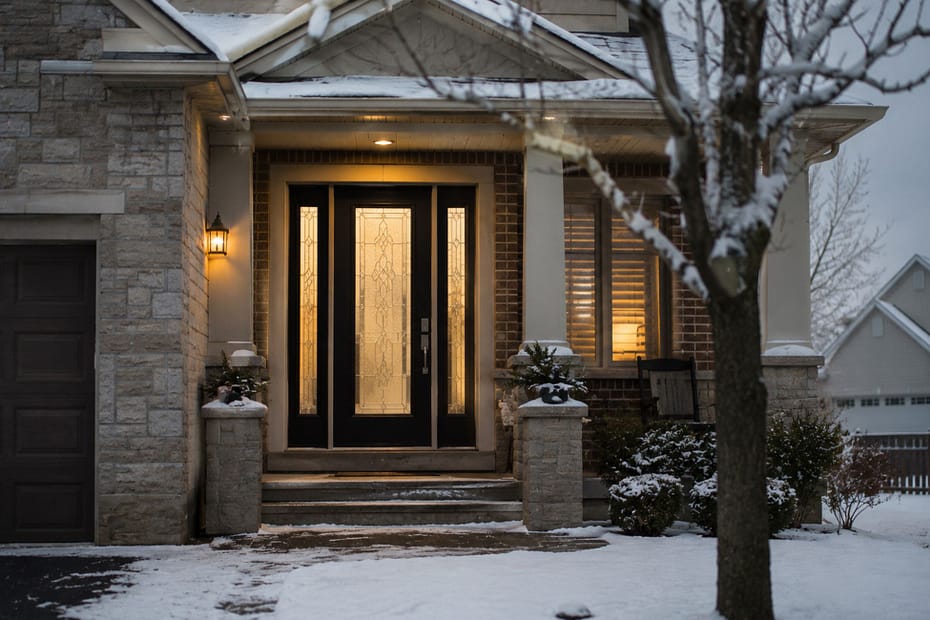
An energy-efficient front door typically saves a modest amount, often tens of dollars per year, compared to an older, drafty door. Larger savings occur only when the existing door has significant air leakage, poor insulation, or failed seals. Actual results depend on installation quality, climate, and the full door system.
A new front door can improve comfort, reduce drafts, and lower heating and cooling demand. However, one door rarely transforms the entire bill. The U.S. Department of Energy notes that poorly insulated or improperly installed exterior doors can contribute to significant heat loss and increased HVAC demand.
Homeowners can call or text Madison Door at (973) 822-1693 or request a quote online. A door specialist will inspect the slab, frame, threshold, and rough opening to identify the best repair or replacement solution.
How much can an energy-efficient front door save NJ homeowners each year?
Most NJ homeowners should expect modest annual savings, with larger gains when the existing opening leaks badly.
A practical planning range starts with tens of dollars yearly. Severe leakage may support more savings, especially with expensive electric heating.
Avoid fixed guarantees without an inspection. A door’s energy efficiency depends on the complete installed system.
| Existing door condition | Likely savings opportunity | Main reason |
| Newer, tight, insulated door | Low | Limited improvement remains |
| Older door with worn seals | Low to moderate | Reduced air leakage |
| Warped wood door with frame gaps | Moderate | Better fit and air sealing |
| Uninsulated door with failed glass | Moderate to high | Less conduction and leakage |
| Damaged door, sill, and jamb | Highest potential | Several energy-loss paths improve |
These levels show opportunity, not guaranteed dollars. Bills include fixed fees, delivery charges, usage, and changing energy market rates.
NJBPU’s June 2026 examples ranged from $137.47 to $201.76 monthly at 650 kWh. Therefore, equal energy reductions can produce different savings.
Why does a front door affect heating and cooling costs?
A front door affects energy costs through heat transfer and air leakage across the slab, frame, and surrounding components like sidelites or glass panels.
These small gaps can increase HVAC runtime. A draft may come from between the frame and the rough opening. Several problems often work together:
- Worn or compressed weather stripping
- Gaps beneath the door sweep
- Poor insulation around the frame
- Warped wood or damaged steel
- Failed seals around decorative glass
- Misaligned hinges, locks, or threshold
- Cracks where exterior trim meets construction
Replacing only the slab may leave these problems untouched. A complete system addresses the frame, threshold, seals, and installation.
What do installers typically see in the field?
In typical front door replacements, installers often find that most energy loss does not come from the door slab itself, but from air leaks around the frame, threshold, and rough opening.
Even higher-quality doors can underperform if the opening is not properly insulated or sealed during installation. This is why air sealing and alignment often produce more noticeable comfort improvements than material upgrades alone.
Which factors contribute most to front door energy savings?
Door condition, air leakage, glazing, climate exposure, and installation quality determine most potential savings.
The following factors matter most:
- Existing condition: Older or drafty doors with poor sealing offer the greatest potential for improvement.
- Heating fuel: Electric resistance heat can make avoided usage more valuable.
- Exposure: Wind-exposed entrances may lose more winter heat.
- Glass area: More glass adds natural light but changes thermal performance.
- Frame condition: Rot and uneven corners prevent reliable seals.
- House efficiency: Better insulation reduces the total heating load.
- Installation: Accurate fitting protects product performance.
Home style also affects installation. Colonial, Cape Cod, Tudor, Victorian, Ranch, Split-Level, and Dutch Colonial homes may have settled openings.
Careful measurement matters in Madison, Chatham, Florham Park, Morristown, Summit, and Short Hills. Standard products may not fit older construction correctly.
How can you estimate your own front door energy savings?
You can estimate potential savings by applying conservative percentage reductions to your annual heating and cooling costs.
Collect 12 months of gas, oil, and electric bills. Estimate heating and cooling spending, then test cautious scenarios.
| Annual heating and cooling spending | 1% reduction | 3% reduction | 5% reduction |
| $1,500 | $15 | $45 | $75 |
| $2,400 | $24 | $72 | $120 |
| $3,600 | $36 | $108 | $180 |
This table shows simple math, not a promised result. For a stronger estimate:
- Review one full year of energy use.
- Note winter and summer peaks.
- Inspect the opening during windy weather.
- Check the sweep, threshold, glass, and jamb.
- Compare the current and proposed NFRC ratings.
- Ask how the installer will seal the rough opening.
- Compare future bills during similar weather periods.
A calibrated blower-door test can quantify whole-house leakage. Avoid any outdated HTTP calculator that promises exact door savings.
How can you tell whether your current front door wastes energy?
Check for daylight gaps, drafts, damaged seals, poor closing, fogged glass, or a warped or rotting frame; these all signal energy loss.
Small leaks can often be fixed with new weatherstripping, but warped slabs, failed glass, or damaged frames usually require door replacement.
Which energy ratings matter for a front door in New Jersey?
NJ homeowners should compare U-factor, SHGC, air leakage, and ENERGY STAR certification.
The National Fenestration Rating Council provides independent ratings for doors, patio doors, and windows.
| Rating or standard | What it measures | What to look for |
| U-factor | Heat passing through the complete product | Lower numbers |
| R-value | Resistance to heat flow | Higher numbers on comparable components |
| SHGC | Solar heat entering through glass | Appropriate value for exposure |
| Air leakage | Air entering through the product | Lower numbers |
| Visible transmittance | Natural light passing through glass | Higher numbers for more daylight |
| ENERGY STAR | Climate-specific efficiency qualification | Certification for the exact configuration |
| AAMA testing | Structural, air, and water performance | Verified product performance |
Do not compare slab-only R-value with whole-door U-factor. The selected glass, sidelites, transom, or Inspirations Art Glass can change ratings.
ENERGY STAR certified doors receive independent testing and NFRC verification. Morris County falls within the Northern climate zone.
Which front door material offers the best energy efficiency?
Fiberglass and insulated steel usually outperform traditional solid wood doors in terms of efficiency and maintenance.
The most energy-efficient doors use durable materials, insulated cores, tight seals, efficient glass, and professional installation.
| Material | Energy performance | Maintenance | Best fit |
| Fiberglass | Strong with a polyurethane foam core | Low | Wood appearance with durability |
| Insulated steel | Strong when properly sealed | Low to moderate | Security and affordable performance |
| Solid wood | Varies by thickness and construction | Higher | Premium natural style |
| Older hollow metal | Often weak | Moderate | Replacement candidate |
| Full-glass system | Depends heavily on glazing | Varies | Maximum natural light |
Fiberglass resists warping and can mimic wood finishes. Insulated steel offers durability and strong baseline efficiency when properly sealed.
ProVia Legacy uses 20-gauge steel construction and is designed for increased durability compared to lighter-gauge alternatives. Wood offers beauty but needs more maintenance.
Which ProVia front door is most energy efficient?
Embarq targets maximum efficiency, while Signet, Heritage, and Legacy balance efficiency with style, security, and cost.
Performance changes with glass, frame, size, sidelites, and installation. Always verify the final NFRC label.
| ProVia line | Material | Efficiency-related features | Best for |
| Embarq | Fiberglass | Thick insulated construction and low U-factor options | Maximum efficiency goals |
| Signet | Fiberglass | Foam-filled core, sturdy stiles, broad glass choices | Premium wood appearance |
| Heritage | Fiberglass | Insulated construction and flexible styling | Value and design balance |
| Legacy Steel | 20-gauge steel | Foam-filled slab and strong construction | Security and durability |
One no-glass Legacy configuration has a published U-factor of 0.17 and air infiltration of 0.04 cfm/ft². Those numbers apply only to that tested combination.
ProVia frame choices include FrameSaver and PermaTech. Select assemblies may also use Q-LON weatherstripping for a compression seal.
Homeowners may compare ProVia with Therma-Tru, Andersen, or Pella door systems. Compare exact ratings instead of relying on brand names.
Confirm current Embarq, Heritage, Signet, or Legacy availability before ordering. Review Madison Door’s ProVia entry doors and 2026 ProVia costs.
Does decorative glass reduce a front door’s energy efficiency?
Yes, decorative glass can slightly reduce a front door’s energy efficiency, but modern insulated glass keeps the difference minimal.
Most performance comes from the glass package rather than the design itself, especially features like multiple panes, Low-E coatings, insulating gas fills, and warm-edge spacers that help control heat transfer.
To evaluate efficiency properly, you should compare the U-factor, SHGC, and air leakage ratings of the full door system rather than focusing only on the decorative style, since high-quality configurations can maintain strong energy performance even with decorative glass.
Does professional installation matter as much as the door?
Professional installation protects performance because gaps can defeat even an efficient door.
The installer must measure the rough opening, confirm it remains square, and inspect the sill. A complete installation should address:
- Accurate opening measurements
- Frame and jamb condition
- Insulation between the frame and wall
- Exterior flashing and sealant
- Threshold and sweep contact
- Weatherstripping compression
- Lock and hinge alignment
A multi-point lock can compress weatherstripping at several locations. Schlage and Emtek hardware must fit the system and support proper alignment.
Will adding a storm door lower utility bills?
A storm door may reduce exposure, but it cannot correct a failing primary entry system.
A storm door can protect the slab and create another air space. However, fit, glass, screens, and sun exposure affect results.
ProVia offers Spectrum, Decorator, and Deluxe storm door lines. Review the ProVia storm door comparison before choosing one.
In some situations, direct sunlight can trap heat between doors. Follow manufacturer guidance for your selected materials and finish.
Can You Get a Federal Tax Credit for an Energy-Efficient Front Door in 2026?
No federal tax credit is currently available for an energy-efficient exterior door purchased and installed in 2026.
The Energy Efficient Home Improvement Credit for exterior doors ended on December 31, 2025. Under the previous rules, homeowners could claim 30% of qualifying product costs. The limit was $250 per door and $500 across all exterior doors.
The previous credit may still matter when filing or amending a return for a qualifying door installed from 2023 through 2025. The door had to meet applicable ENERGY STAR requirements. It also had to serve the homeowner’s principal residence.
Homeowners installing a new front door in 2026 should not include this expired credit in their payback estimate. Instead, check current New Jersey programs, utility rebates, manufacturer offers, and available financing.
Madison Door offers financing options through participating lenders. Financing can spread the project cost, but it does not reduce the door’s purchase price or guarantee energy savings.
Is replacing your front door worth the money?
Replacing a failing front door can be worthwhile because it improves comfort, reduces drafts, and may lower heating and cooling costs, but energy savings alone are usually modest.
Most homeowners choose replacement for a combination of benefits, including better energy efficiency, security, durability, lower maintenance, and improved curb appeal, rather than short-term utility bill savings.
Get a Front Door Built for Your NJ Home
Madison Door provides custom products and professional installation across Morris County.
Contact Madison Door at (973) 822-1693 or request a free quote request a quote to compare materials, glass options, and efficiency ratings for your home.
Key Takeaways
- Most energy-efficient front doors produce modest utility savings, with the biggest gains coming from replacing drafty or poorly installed systems.
- The greatest opportunity comes from replacing a drafty, uninsulated, damaged, or poorly installed system.
- Compare NFRC U-factor, SHGC, air leakage, and ENERGY STAR certification for the exact configuration.
- Fiberglass and insulated steel doors offer strong efficiency, durability, and low maintenance.
- Glass, sidelites, weatherstripping, frame condition, and installation all affect the final performance.
FAQs
How much money can a new front door save each month in New Jersey?
A new front door may save only a few dollars monthly in many homes, while severely leaky openings may save more. Savings depend on the old door, rates, air sealing, and installation.
What U-factor is good for a front door in New Jersey?
A lower U-factor provides better resistance to heat loss, but homeowners should compare ENERGY STAR certified products for the Northern climate zone. Check the NFRC label for the exact glass, frame, and sidelite configuration.
Can new weatherstripping lower heating costs?
New weatherstripping can lower heating costs when worn seals allow measurable air leakage around an otherwise sound door. Weatherstripping will not correct a warped slab, rotten frame, or badly damaged threshold.
Do sidelites make an entry door less energy efficient?
Sidelites can change the system’s U-factor because they add glass and additional frame connections. Efficient low-E glass and careful installation can reduce that effect.